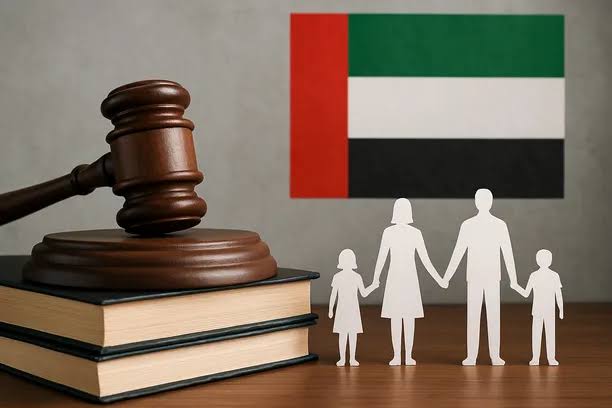

Child rights are given importance across the globe. Similarly, the UAE has also taken a landmark initiative to protect children’s rights under the WADEEMA LAW. Child protection is prioritized in familial matters where parental responsibilities are identified to avoid conflicts.
At the federal level, child custody matters in the UAE are principally governed by Federal Decree-Law No. 41 of 2024 on Personal Status and Federal Decree-Law No. 41 of 2022 on Civil Personal Status for non-Muslims, depending on the parties and the applicable legal regime. The law mainly focuses on the well-being of the child irrespective of their nationality, background, ethnicity, and religion. Nonetheless, physical, mental, and emotional wellness is emphasized, especially in Child custody law where children are at stake. Additionally, financial and educational needs are also taken into consideration along with ensuring a safe and secure living environment.
Federal Decree-Law No. 41 of 2022 for UAE Non-Muslims:
Federal Decree-Law No. 41 of 2022 applies to non-Muslim UAE citizens and non-Muslim foreign residents of the UAE, subject to the choice-of-law provisions contained in the Decree-Law. The law was introduced in 2022, which was officially effective from 2nd February 2023. Under Article 1, the Decree-Law applies to non-Muslim UAE citizens and non-Muslim foreign residents, unless a person invokes the law of their home country in relation to matters specified by the law, including marriage, divorce, inheritance, wills and proof of parentage. Persons governed by the Decree-Law may also agree to apply other family or personal-status legislation in force in the UAE where legally permitted
Federal Decree-Law No. 41 of 2024 for Muslims Citizens:
Federal Decree law no 41 of 2024 is primarily applicable to Muslims and UAE citizens who are of the Islamic Faith. This was revised in 2024 and is formally effective from 15th April 2025. However, it can be applied to non-Muslim citizens of the UAE if they agree to the application of the law. UAE family Laws are usually complex in nature, and thus, it is suggested to seek a family lawyer in the UAE for legal representation if you are facing child custody matters in the UAE.
What is the distinction between Child Custody and the Concept of Guardianship?
Normally, individuals think the two concepts are synonym to each other. However, there are different laws for Child custody in the UAE as compared to Guardianship.
HADANAH primarily relates to the physical custody of the child and its day-to-day upbringing. HADANAH stays with the mother of the child, who takes care of the physical, emotional, and mental welfare of the child on a daily basis. It covers daily meals to the day-to-day needs of the child. Hadanah refers to the custody, upbringing and day-to-day care of the child. Under Federal Decree-Law No. 41 of 2024, custody is exercised by both parents while the marriage continues. Following separation, the mother has first priority for custody, followed by the father and others in the statutory order, although the court may depart from that order where the child’s best interests require it
UAE Personal Status law favors the mother for child custody, but it also reviews and analyzes the capacity of the mother in respect to daily care and support towards the child. On the other hand, the term Waliyah refers to guardianship. It mainly relates to taking care of the best interests, legal decisions, and financial support towards the child.
It considers wellness in a broader perspective and covers the education, housing, healthcare, financial care, and traveling authority. Guardianship is usually assigned to the father of the child as per UAE Personal Status law.
Explain: Latest Developments Concerning the Child Custody Laws in the UAE:
In today’s multipolar world, the UAE has taken the first step in becoming a multicultural nation. It warmly welcomes everyone coming from various classes, colors, creeds, and sexes. UAE family laws are aligned with international standards in safeguarding children’s rights.
Moreover, UAE Family laws are specifically designed to protect children’s rights without any discrimination based on nationality, religion, or background.
Over the years, the evolution is taking place as the UAE is liberating itself and also ensuring the maximum protection of non-Muslims along with Muslims and its own citizens.
The prime goal is to strengthen family life and also preserve the rights of children in the region. UAE family Courts always try to normalize family ties and make sincere efforts to bring them together with fairness and justice.
Divorce is not an overwhelming experience for spouses; it equally impacts the children’s wellness. It is termed an emotional rollercoaster where children also face the implications of a bad marriage.
Over time, the UAE government has amended the regulations to make sure the best interests are intact and that whatever the outcome primarily favors the children in a marriage.
Therefore, UAE family courts prioritize the safety and well-being of the child, and thus parental responsibility is assigned accordingly to both parents.
The new concept of equal parental responsibility has been introduced to support child rights and ensure their interests are secured.
Non-Muslims can avail the option to seek Joint Custody, which was never possible before. The concept of Joint child custody is termed a pragmatic move toward child development and the future.
Eligibility and Application for Child Custody in the UAE:
UAE Family Courts will carefully analyze and review various aspects before deciding on child custody. In some cases, the extended family may take care of the child if both parents are unfit for custody. They may consider the grandparents or close blood relatives.
Besides, the UAE court will make sure the custodian ensures a safe and better living environment for the child. The process of applying for child custody begins immediately after the divorce is finalized.
What is the Procedure for the Child Custody Case in the UAE?
Family disputes may arise due to various reasoning and thus the initial efforts are dedicated by UAE Courts to an amicable settlement between husband and wife for the betterment of the child. For this, negotiations and mediation are highly encouraged.
A written filing of the child custody case is imperative to begin legal proceedings. The UAE family courts will work after a request. The formal legal documents are submitted to the courts. After a failed mediation process, Court hearings will commence.
Both parents must make court appearances, and the judges will review the case in detail. The arguments, documents, and supporting evidence are analyzed before passing a final verdict.
They will assess the child’s well-being, and thus the child welfare authorities may evaluate the cases. It is recommended to seek legal guidance from a professional family expert.